Embroidery
Embroidery
Whether you are embroidering by hand or machine having the right tools etc., are important.
Embroidery

Gold embroidery on the gognots (apron) of a 19th-century Armenian bridal dress from Akhaltsikhe.
The basic techniques or stitches on surviving examples of the earliest embroidery—chain stitch, buttonhole or blanket stitch, running stitch, satin stitch, cross stitch—remain the fundamental techniques of hand embroidery today.
Contents
History

Traditional embroidery in chain stitch on a Kazakh rug, contemporary.

Caucasian embroidery
Origins
The process used to tailor, patch, mend and reinforce cloth fostered the development of sewing techniques, and the decorative possibilities of sewing led to the art of embroidery.[1] Indeed, the remarkable stability of basic embroidery stitches has been noted:It is a striking fact that in the development of embroidery ... there are no changes of materials or techniques which can be felt or interpreted as advances from a primitive to a later, more refined stage. On the other hand, we often find in early works a technical accomplishment and high standard of craftsmanship rarely attained in later times.[2]The art of embroidery has been found world-wide and several early examples have been found. Works in China have been dated to the Warring States period (5th–3rd century BC).[3] In a garment from Migration period Sweden, roughly 300–700 AD, the edges of bands of trimming are reinforced with running stitch, back stitch, stem stitch, tailor's buttonhole stitch, and whip-stitching, but it is uncertain whether this work simply reinforced the seams or should be interpreted as decorative embroidery.[4]
Historical applications and techniques
Depending on time, location and materials available, embroidery could be the domain of a few experts or a wide-spread, popular technique. This flexibility led to a variety of works, from the royal to the mundane.Elaborately embroidered clothing, religious objects, and household items often were seen as a mark of wealth and status, as in the case of Opus Anglicanum, a technique used by professional workshops and guilds in medieval England.[5] In 18th century England and its colonies, samplers employing fine silks were produced by the daughters of wealthy families. Embroidery was a skill marking a girl's path into womanhood as well as conveying rank and social standing.[6]
Conversely, embroidery is also a folk art, using materials that were accessible to nonprofessionals. Examples include Hardanger from Norway, Merezhka from Ukraine, Mountmellick embroidery from Ireland, Nakshi kantha from Bangladesh and West Bengal, and Brazilian embroidery. Many techniques had a practical use such as Sashiko from Japan, which was used as a way to reinforce clothing.[citation needed]
The Islamic world

Morocco fez horse cover metal silver thread 18th – 19th
In the 16th century, in the reign of the Mughal Emperor Akbar, his chronicler Abu al-Fazl ibn Mubarak wrote in the famous Ain-i-Akbari: "His majesty (Akbar) pays much attention to various stuffs; hence Irani, Ottoman, and Mongolian articles of wear are in much abundance especially textiles embroidered in the patterns of Nakshi, Saadi, Chikhan, Ari, Zardozi, Wastli, Gota and Kohra. The imperial workshops in the towns of Lahore, Agra, Fatehpur and Ahmedabad turn out many masterpieces of workmanship in fabrics, and the figures and patterns, knots and variety of fashions which now prevail astonish even the most experienced travelers. Taste for fine material has since become general, and the drapery of embroidered fabrics used at feasts surpasses every description."[8]
Automation
The development of machine embroidery and its mass production came about in stages in the Industrial Revolution. The earliest machine embroidery used a combination of machine looms and teams of women embroidering the textiles by hand. This was done in France by the mid-1800s.[9] The manufacture of machine-made embroideries in St. Gallen in eastern Switzerland flourished in the latter half of the 19th century.[10]
Hand-made embroidery – Székely Land, 2014
Classification

Japanese free embroidery in silk and metal threads, contemporary.

In free or surface embroidery, designs are applied without regard to the weave of the underlying fabric. Examples include crewel and traditional Chinese and Japanese embroidery.


Embroidery can also be classified by the similarity of appearance. In drawn thread work and cutwork, the foundation fabric is deformed or cut away to create holes that are then embellished with embroidery, often with thread in the same color as the foundation fabric. When created with white thread on white linen or cotton, this work is collectively referred to as whitework.[13] However, whitework can either be counted or free. Hardanger embroidery is a counted embroidery and the designs are often geometric.[14] Conversely, styles such as Broderie anglaise are similar to free embroidery, with floral or abstract designs that are not dependent on the weave of the fabric.[15]
Materials

Phulkari from the Punjab region
of India. Phulkari embroidery, popular since at least the 15th century,
is traditionally done on hand-spun cotton cloth with simple darning
stitches using silk floss.

Laid threads, a surface technique in wool on linen. The Bayeux Tapestry, 11th century.
Surface embroidery techniques such as chain stitch and couching or laid-work are the most economical of expensive yarns; couching is generally used for goldwork. Canvas work techniques, in which large amounts of yarn are buried on the back of the work, use more materials but provide a sturdier and more substantial finished textile.[17]
In both canvas work and surface embroidery an embroidery hoop or frame can be used to stretch the material and ensure even stitching tension that prevents pattern distortion. Modern canvas work tends to follow symmetrical counted stitching patterns with designs emerging from the repetition of one or just a few similar stitches in a variety of hues. In contrast, many forms of surface embroidery make use of a wide range of stitching patterns in a single piece of work.[18]
Machine

Commercial machine embroidery in chain stitch on a voile curtain, China, early 21st century.
There has also been a development in free hand machine embroidery, new machines have been designed that allow for the user to create free-motion embroidery which has its place in textile arts, quilting, dressmaking, home furnishings and more.[19]
Qualifications
City and Guilds qualification[20] in Embroidery allows embroiderers to become recognized for their skill. This qualification also gives them the credibility to teach. For example, the notable textiles artist, Kathleen Laurel Sage- Textiles Artist,[21] began her teaching career by getting the City and Guilds Embroidery 1 and 2 qualifications. She has now gone on to write a book on the subject.[22]Gallery
-
 Detail of embroidered silk gauze ritual garment. Rows of even, round chain stitch used for outline and color. 4th century BC, Zhou tomb at Mashan, Hubei, China.
 -
 English cope, late 15th or early 16th century. Silk velvet embroidered with silk and gold threads, closely laid and couched. Contemporary Art Institute of Chicago textile collection.
 -
 Extremely fine underlay of St. Gallen Embroidery
 -
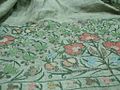 Traditional Turkish embroidery. Izmir Ethnography Museum, Turkey.
 -
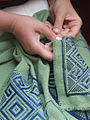 Traditional Croatian embroidery.
 -
 Brightly coloured Korean embroidery.
 -
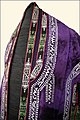 Uzbekistan embroidery on a traditional women's parandja robe.
 -
 Traditional Peruvian embroidered floral motifs.
 -
 Woman wearing a traditional embroidered Kalash headdress, Pakistan.
 -
 Decorative embroidery on a tefillin bag in Jerusalem, Israel.
 -
 Bookmark of black fabric with multicolored Bedouin embroidery and tassel of embroidery floss
 -
 Chain-stitch embroidery from England circa 1775
 -
 Traditional Bulgarian Floral embrodery from Sofia and Trun


See also
Notes
- The Zen Cart® Team; et al. "Embroidered Soldered and Heat Zapped Surfaces by Kathleen Laurel Sage".
References
 |
Wikimedia Commons has media related to Embroidery. |
- Berman, Pat (2000). "Berlin Work". American Needlepoint Guild. Retrieved 2009-01-24.
- Caulfield, S.F.A.; B.C. Saward (1885). The Dictionary of Needlework.
- Crummy, Andrew (2010). The Prestonpans Tapestry 1745. Burke's Peerage & Gentry, for Battle of Prestonpans (1745) Heritage Trust.
- Embroiderers' Guild Practical Study Group (1984). Needlework School. QED Publishers. ISBN 0-89009-785-2.
- Gillow, John; Bryan Sentance (1999). World Textiles. Bulfinch Press/Little, Brown. ISBN 0-8212-2621-5.
- Lemon, Jane (2004). Metal Thread Embroidery. Sterling. ISBN 0-7134-8926-X.
- Levey, S. M.; D. King (1993). The Victoria and Albert Museum's Textile Collection Vol. 3: Embroidery in Britain from 1200 to 1750. Victoria and Albert Museum. ISBN 1-85177-126-3.
- Netherton, Robin, and Gale R. Owen-Crocker, editors, (2005). Medieval Clothing and Textiles, Volume 1. Boydell Press. ISBN 1-84383-123-6.
- Quinault, Marie-Jo (2003). Filet Lace, Introduction to the Linen Stitch. Trafford Publishing. ISBN 1-4120-1549-9.
- Readers Digest (1979). Complete Guide to Needlework. Readers Digest. ISBN 0-89577-059-8.
- van Niekerk, Di (2006). A Perfect World in Ribbon Embroidery and Stumpwork. ISBN 1-84448-231-6.
- Vogelsang, Gillian; Willem Vogelsang, editors (2015). TRC Needles. The TRC Digital Encyclopaedia of Decorative Needlework. Textile Research Centre, Leiden, The Netherlands.
- Wilson, David M. (1985). The Bayeux Tapestry. Thames and Hudson. ISBN 0-500-25122-3.


Comments
Post a Comment